
Product Introduction
This chapter introduces the platform positioning, key capabilities, overall architecture, and basic concepts of ZCF to help users understand the overall platform before reading the functional chapters.
What Is ZCF?
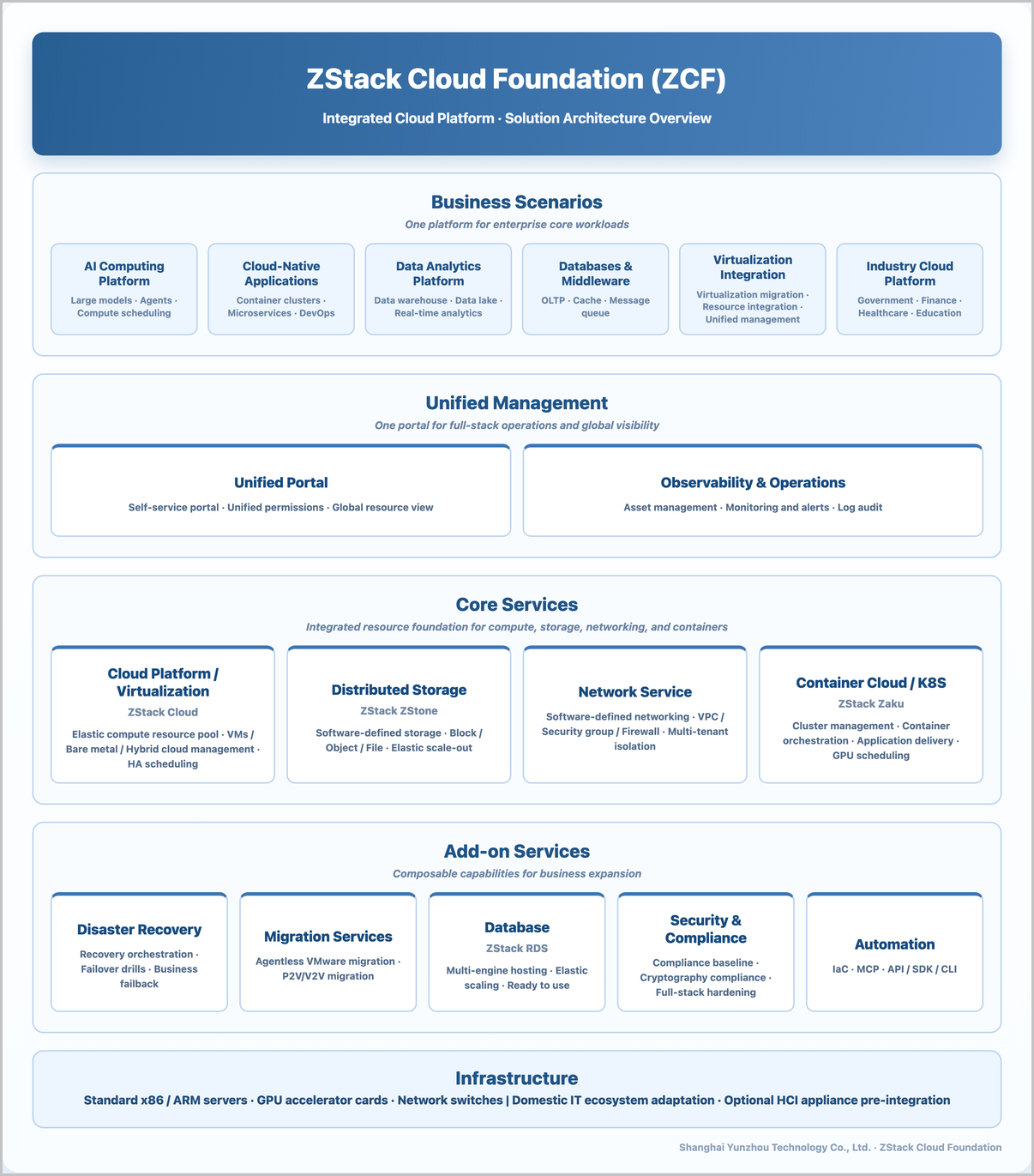
ZStack Cloud Foundation (ZCF) is a unified cloud infrastructure platform for the ZStack product portfolio. It covers compute, storage, container, network, unified access, and observability and operations capabilities to help users build and manage cloud infrastructure with a consistent architecture.
For infrastructure deployment and operations across multiple products and environments, ZCF organizes product environments, infrastructure resources, and operations data into a unified platform. It provides a consistent experience for access, management, and analysis, reducing the complexity of managing separate systems and improving the efficiency of delivering, operating, and scaling cloud infrastructure.
Key Capabilities
ZCF provides the following key capabilities:
- Cloud infrastructure deployment: Provides compute, storage, and network virtualization capabilities to support unified deployment, delivery, and scaling of VM instances, volumes, service networks, highly available storage, and base network services.
- Workload hosting: Provides infrastructure support from resource provisioning and network connectivity to application running for VM, container, AI computing, and data analytics workloads.
- Unified access and governance: Provides unified entry, unified identity authentication, access control, and permission management, helping users access resources and services with a consistent experience.
- Centralized operations management: Provides deployment, connection, licensing, resource views, Cloud Federation, and basic operations management capabilities to support the continuous operation of cloud infrastructure environments.
- Security services: Provides audit, operations access control, and host protection capabilities for cloud infrastructure security governance, helping users establish a security assurance system that covers operation traceability, access boundaries, and runtime risk protection.
- Observability and operations analytics: Aggregates resources, assets, metrics, logs, platform health, alarms, dashboards, and reports to support operating-status viewing, inspections, capacity analysis, alarm tracking, and troubleshooting.
Composition and Capabilities
ZCF capabilities cover cloud resource virtualization, distributed storage, containers, network services, Unified Portal, Cloud Federation, operations analytics, Alarm Center, Security Service, lifecycle management, and installation and deployment. The following table describes the major ZCF parts and their capabilities from a usage perspective.
| Part | Capability Description |
|---|---|
| ZStack Cloud |
|
| ZStack ZStone |
|
| ZStack Zaku |
|
| ZCF Network Service (ZNS) |
|
| ZCF Unified Portal |
|
| ZCF Cloud Federation |
|
| ZCF Observability |
|
| ZCF Installer |
|
| ZCF Lifecycle Management |
|
Concept Model
ZCF uses a unified management model to organize infrastructure resources, identity objects, operations data, alarms, and lifecycle objects. Users can perform unified onboarding, access control, operations analytics, alarm management, and upgrade maintenance in Global Management, and can switch to a specific region to view and manage the corresponding infrastructure resources.
| Concept | Description |
|---|---|
| ZCF Environment | A ZCF platform environment deployed and used by users. A ZCF environment can include cloud resource virtualization, distributed storage, containers, network services, Unified Portal, Cloud Federation, operations analytics, Alarm Center, lifecycle management, licensing, and installation and deployment capabilities. |
| Global Management | A management scope for cross-region and cross-environment capabilities. After switching to Global Management, users can perform environment connection, access control, operations analytics, alarm management, lifecycle management, and network service management. |
| Region | A management scope for infrastructure resources. Users can switch to a specific region to view and manage cloud platform, storage, container, and other resources in that region. |
| Connected Environment | An infrastructure environment brought into the unified ZCF management scope. After connection, its resources, metrics, logs, identity configuration, or Security Service capabilities can work with ZCF according to the scenario. |
| ZCF Cloud Federation | A capability for bringing different infrastructure environments into the unified ZCF management scope and maintaining ownership, access credentials, connection status, and version context. With ZCF Cloud Federation, production, test, disaster recovery, or remote-site environments can be organized by region or Global Management scope, and basic information can be provided for pre-upgrade checks in Lifecycle Management. |
| Unified Portal | The unified access interface used after users log in to ZCF. It is used to switch management views and access resources and services in the unified management scope. |
| Unified Identity Source | The source that stores user accounts and authentication information. After a unified identity source is connected, users can log in to ZCF and resources or services configured with unified authentication through unified identity login. |
| Access Control | A capability for managing authorization relationships among users, user groups, projects, roles, and organizations. Administrators can view permission distribution, identify inherited roles, and maintain access boundaries for resources and functions. |
| Operations Data | Assets, metrics, logs, platform health, dashboards, views, and reports collected or aggregated in the unified management scope for operating-status observation, troubleshooting, and capacity analysis. |
| Alarm Center | A capability for centrally handling alarms. Users can view alarm messages, maintain alarm rules and notification settings, and track risk discovery and notification delivery in one place. |
| Platform Health | A health view for key platform services, health domains, component details, and external dependencies. It helps users discover platform capacity, service, and pipeline risks early. |
| Security Service | Security capability extensions provided by ZCF. Current scenarios include log audit, bastion host, and host security EDR, supporting VM audit, operations access, and host protection. |
| ZCF Bundle | A package set used for ZCF installation or later-version upgrade. Administrators can prepare and manage ZCF Bundles in Lifecycle Management, and the system uses package status, version constraints, and component status in Cloud Federation to determine whether an upgrade plan can be created. |
| Upgrade Plan | An upgrade execution object created from a ZCF Bundle. It connects upgrade processes such as risk checks, pre-upgrade preparation, execution monitoring, failure diagnosis, and history tracking. |
Quick Start
When using ZCF for the first time, you can follow the path below to prepare the environment, deploy the platform, configure licensing, connect environments, configure access control, perform routine operations, and maintain later upgrades. The table provides a recommended reading order and chapter entry points.
| Stage | Goal | Main Tasks | Reference Chapters |
|---|---|---|---|
| Understand ZCF | Build an overall understanding |
|
|
| Prepare the environment | Meet deployment prerequisites |
|
|
| Deploy ZCF | Complete platform deployment |
|
|
| Configure licensing | Prepare authorization |
|
|
| Connect environments | Build the unified management scope |
|
|
| Configure access and identity | Build a unified access experience |
|
|
| Use resources and services | Manage business resources |
|
|
| Operations analytics | Continuously view operating status |
|
|
| Upgrade maintenance | Manage later version upgrades |
|
Lifecycle Management |