License Management
What is License?
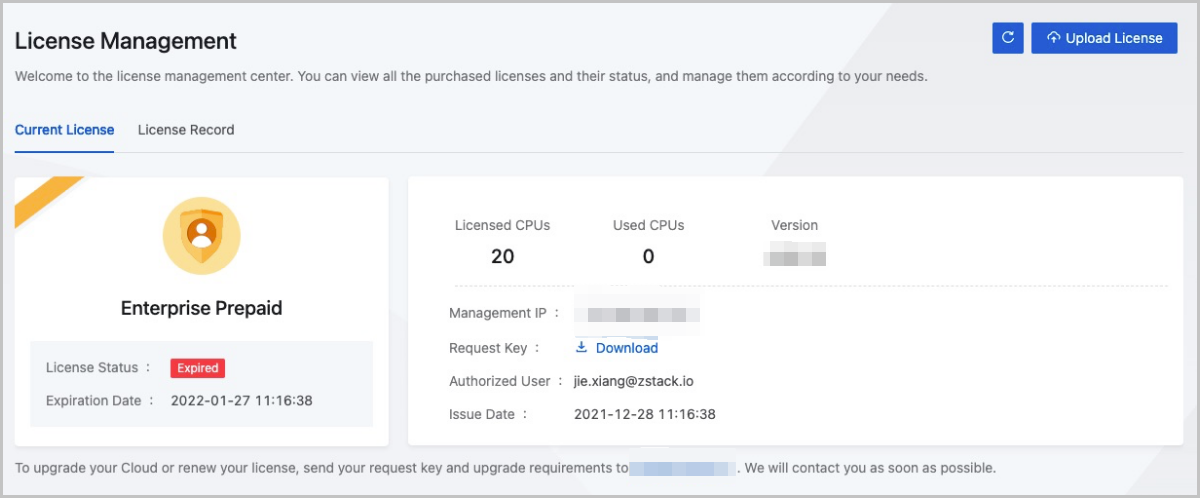
The License Management page displays the licensing information such as the licensing mechanism, Cloud version, and license status.
On the ZStack Cloud main menu, click the profile icon and choose License Management. Then, the License Management page is displayed.

Licensing Mechanism
- Base License
- Provides the basic and essential features of the Cloud, which can meet the mainstream business requirements.
- Covered functionalities: Standard, Enterprise Trial, and Enterprise Prepaid. For more detailed information about these editions, see contact official sales.
- Plus License
- Provides add-on features or feature enhancements to meet the specific business requirements.
- Covered functionalities: VMware Management, Tenant Management, ARM64 Management, Backup Service, Continuous Data Protection (CDP) Service, Cryptography Security Compliance, Baremetal Management, Elastic Baremetal Management, Alibaba Cloud Hybrid Cloud Management, 5x8 (7x24) After-Sales Service, SR-IOV NIC Service, GPU Service, Billing Management, CloudFormation, Auto-Scaling Service, SDN Network, Container Service-CPU, and Container Service-vCPU.
- A Base license is required to install the Plus license.
| Licensing Mechanism | Functionality Covered | Description |
|---|---|---|
| / | Community |
Provides a simple, ease-of-use, and productized private cloud
platform with diversified features for community users.
|
| Base License | Standard |
Provides a full set of computing, storage, and network
virtualization features. This helps to meet the various and
flexible business requirements.
|
| Enterprise Trial |
Provides a full set of computing, storage, and network
virtualization features, and enhanced features such as GPU,
CloudFormation, and auto-scaling. This helps to meet the
various and flexible business requirements.
|
|
| Enterprise Prepaid |
Provides a full set of computing, storage, and network
virtualization features, and enhanced features such as GPU,
CloudFormation, and auto-scaling. This helps to meet the
various and flexible business requirements.
|
|
| Plus License | VMware Management |
Manages all the features of vCenter and provides an
independent CPU license for VMware compute nodes.
|
| Tenant Management |
Provides the full functionalities of Tenant Management, such as project management, organizational structure, users, permissions, and Cloud operations, during the licensed period.
|
|
| ARM64 Management |
Provides a specified number of ARM hosts within the licensed
period, and provides stable support for ARM64 servers.
|
|
| Backup Service |
Backs up VM data to backup servers online in various
scenarios, such as local backup, remote backup, and hybrid
cloud backup. This enhances the data reliability.
|
|
| Continuous Data Protection (CDP) Service |
Provides second-level and fine-grained continuous data
protection for VM instances, ensuring that VM instances can
quickly recover when a failure occurs.
|
|
| Baremetal Management |
Provides a specified number of dedicated physical servers
within the licensed period to ensure the high performance
and stability of core applications.
|
|
| Cryptography Security Compliance |
Provides applications with cloud security capabilities based
on commercial cryptographies, meeting the requirements of
commercial cryptography application security assessments.
|
|
| Elastic Baremetal Management |
Provides the license for managing specified number of
flexible physical servers during the licensed period,
improving the ease of use and flexibility in addition to
ensuring the high performance and stability of physical
servers.
|
|
| Alibaba Cloud Hybrid Cloud Management |
Provides all features of Alibaba Cloud Hybrid Cloud
Management, realizing the interconnection between the
control plane and the data plane.
|
|
| Container Service-CPU |
Provides independent CPU license for an enterprise-level
container service, enabling you to conveniently use
multiple-tenant management, multiple cluster management,
resource allocation, CI/CD, microservice governance, and
other container-related features.
|
|
| Container Service-vCPU |
Provides independent vCPU license for an enterprise-level
container service, enabling you to conveniently use
multiple-tenant management, multiple-cluster management,
resource allocation, CI/CD, microservice governance, and
other container-related features.
|
|
| 5x8 (7x24) After-Sales Service |
Provides 5x8 or 7x24 official after-sales technical support
within the specified period.
|
|
| SR-IOV NIC Service |
Allows you to generate VF NICs from physical NICs based on
the SR-IOV specification and allocate these VF NICs to VM
instances. This provides VM instances strong I/O performance
comparable to that of physical NICs.
|
|
| GPU Service | Allows you to passthrough a physical GPU
(pGPU) to VM instances or divide a pGPU into multiple virtual
GPUs (vGPUs) and distribute the vGPUs to VM instances. This
empowers VM instances with strong computing capabilities of
physical GPUs.
|
|
| Billing Management | Provides billing methods like that of the
public cloud, uses pricing lists to manage billing of resources
of various unit prices, and offers billing services to the admin
and tenants based on the pricing lists.
|
|
| CloudFormation | Uses stack templates to batch deploy and
configure resources and manage the lifecycle of the resources.
In addition, offers designers that allow efficient orchestration
of cloud resources.
|
|
| Auto-Scaling Service | Allows automatic scale-in or scale-out of VM
instances based on the load balancing result of application
workloads, thereby improving resource utilization, lowering
maintenance costs, and securing stable business operations.
|
|
| SDN Network | Supports hardware SDN integration and
provides advanced network service management capabilities based
on OVS-DPDK software SDN networks.
|
|
| SE Device | Supports SE device detection and management,
including virtualization/ungeneration and attachment to VM
instances, which provides security and encryption services.
|
 Note:
Note:
- For more details, contact us by sending emails to sales@zstack.io.
- To obtain a trial, or to purchase or upgrade your ZStack Cloud license, send your key ID or request key with your requirements to sales@zstack.io. We will contact you as soon as possible.
Licensing Method
- Local Licensing: Install local licenses using either a request key or
an USB key. The Cloud consumes the local license quota.
- USB Key: Plug the authorization USB Key into the management node to complete the local license installation.
- Request Key: Use the request key to apply for licenses and upload the obtained license file locally to complete the installation.
- Server Licensing: Connect to a license server and consume the license
quota shared from the license server.
- License Server: A license server is essentially a cloud platform with the License Sharing feature enabled. Therefore, it can share its license quota with other cloud platforms and acts as a License server.
- Client Site: A client site refers to a cloud platform that connects to a license server and consumes license quota shared from it.
Install a License
- Local Licensing: Install local licenses using either a request key or an
USB key. The Cloud consumes the local license quota.
- USB Key: Plug the authorization USB Key into the management node to complete the local license installation.
- Request Key: Use the request key to apply for licenses and upload the obtained license file locally to complete the installation.
- Server Licensing: Connect to a license server and consume the license quota on the license server.
Local Licensing (USB Key)
This topic details the method for local authorization using a USB key, covering the license installation, license renewal, and USB key status verification.
Install License
- Insert the USB key into the management node.
- On the main menu of ZStack Cloud, choose . Then, the License Management page is displayed.
- On the License Management page, click the
Refresh button to the left of Upload
License.
图 1. Refresh License 
- Then, you can see the whole licensing information.
图 2. Whole Licensing Information 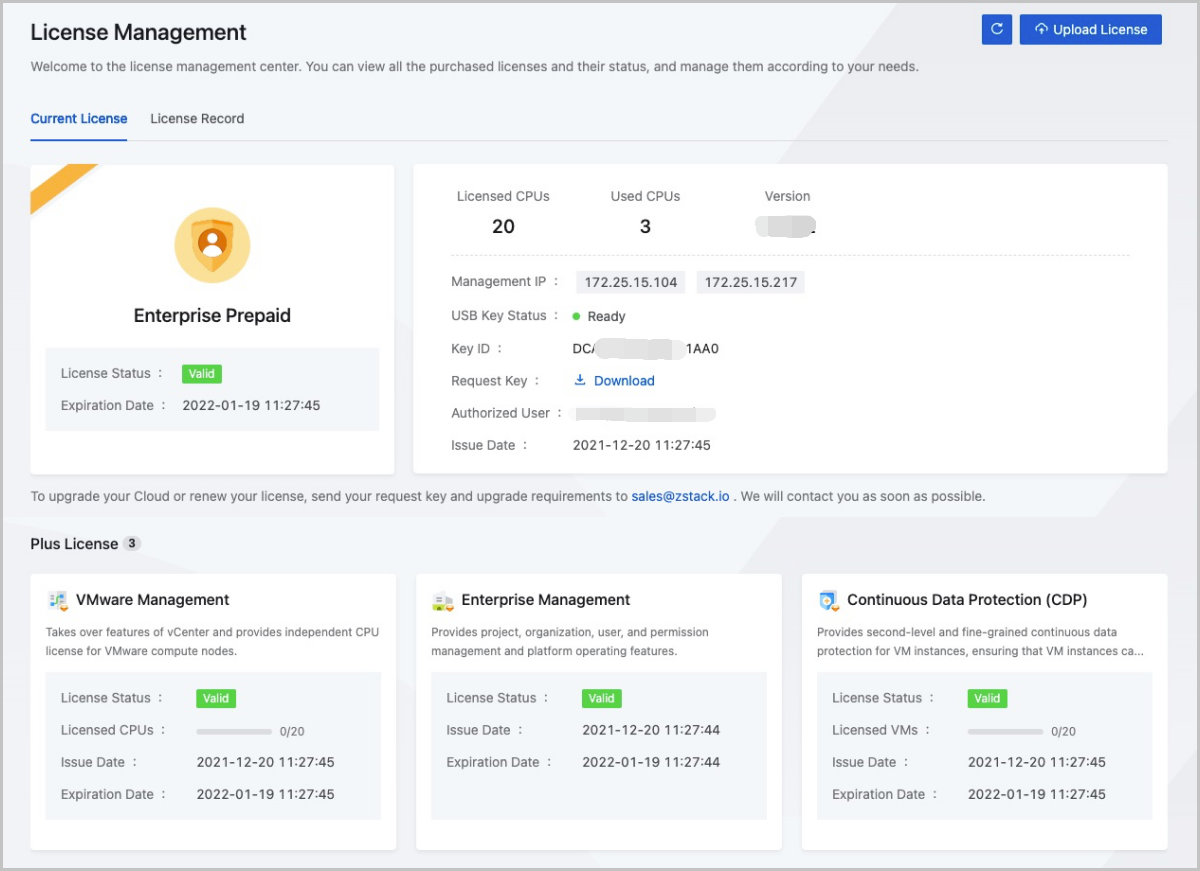
Note:
- If you have got a license by using a request key, you can view Plus License of both the request key and USB key after inserting the USB key. If the Plus License is the same, the latest uploaded one will be taken as a reference.
- If you get a license by using the USB key, every time you enter the License Management interface of the Cloud, there will be about two seconds of information reading, and the relevant information of the USB key will appear after two seconds.
- If you are using a dual-MN environment, note that:
- You can obtain the authorization by inserting only one USB key into the management node.
- If the node with the USB key inserted is faulty, we recommend that you remove the USB key and insert it into another healthy node to ensure the business continuity.
- If you update from a single management node environment to a dual-MN environment, you do not need to get the additional license.
Renew License
- Insert the USB key into the management node.
- On the main menu of ZStack Cloud, choose . Then, the License Management page is displayed.
- On the License Management page, click the Copy
button to the right of the Key ID.
图 3. Copy Key ID 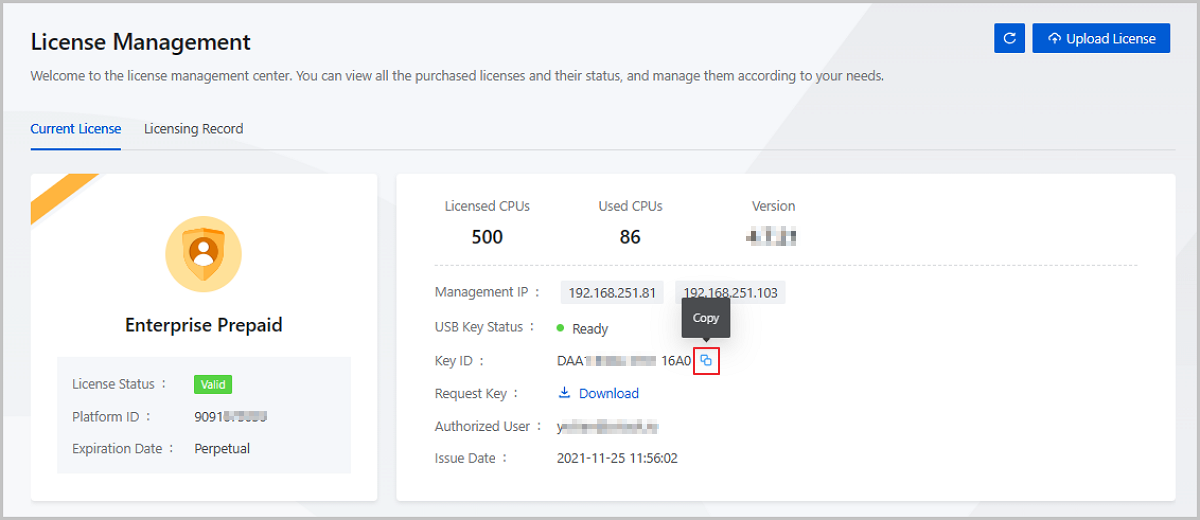
- Apply for a license by using the USB Key ID to get the licensing file.
- Go back to the License Management page, Click
Upload License to upload the licensing file.
图 4. Upload License 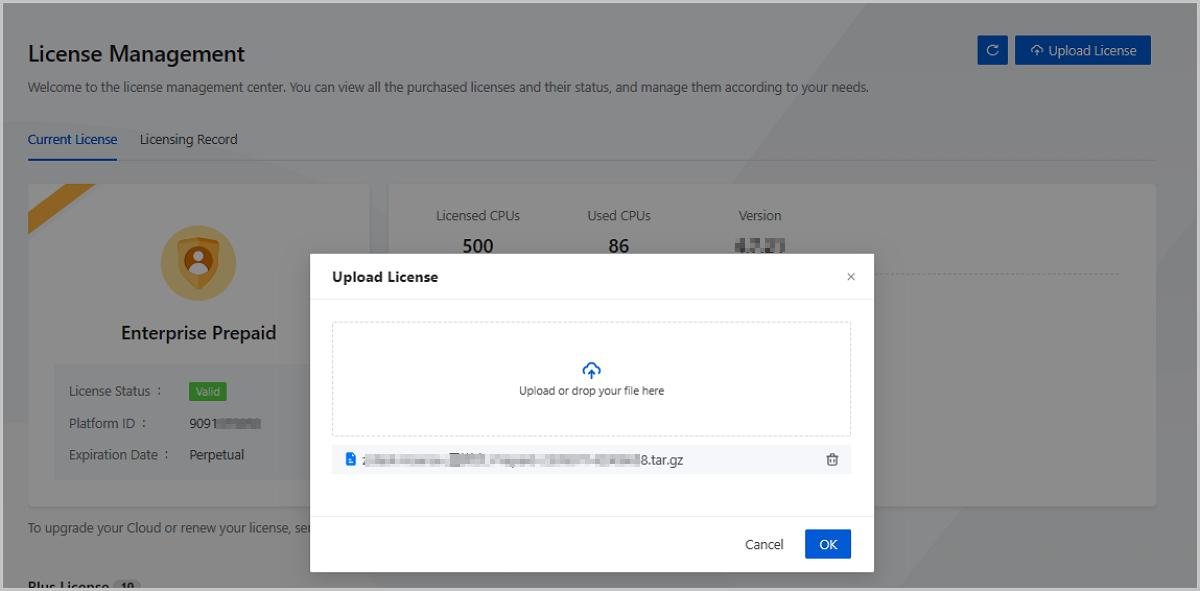
- Check whether the licensing information is correct.
Note:
- If you do not insert a USB key into the management node, you can not upload a license by using the USB key.
- If the USB key ID dose not match the applied license, you can not upload the license by using the USB key.
- If you apply a new license by using a USB key, you need to fill in previous all applied information and then add new Plus License information when the USB key does not match the request key.
View USB Key Status
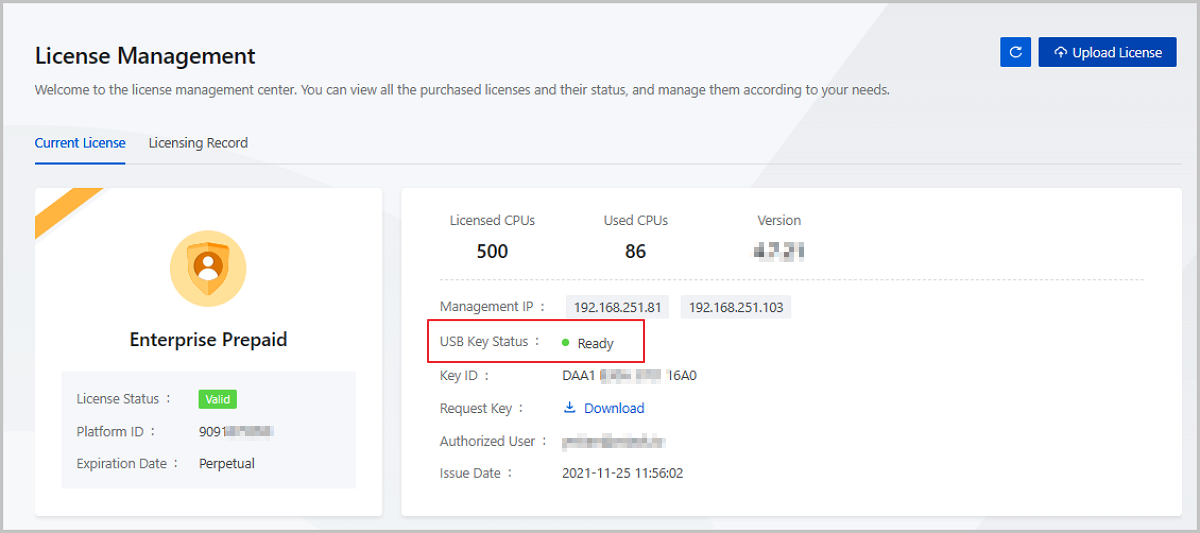
On the main menu of ZStack Cloud, choose . Then, the License Management page is displayed. You can view the current status of the USB key of the Cloud.
USB Key Status
| Status | Description |
|---|---|
| Ready | The USB key is Ready when there is only one USB key inserted into the management node and it works properly. |
| Missing | After unplugging the USB key, the USB key is
Missing.Note: When unplugging the USB key, the Cloud will
check whether the current license is expired.
|
| Abnormal | For a dual-MN environment, you might face a
possibility of USB key failure if you:
Note: The USB key in an abnormal state does not affect the
license. |
| Fault |
Note: When the USB key status is Faulty, you can not use the
license after the buffer license is expired. |
Local Licensing (Request Key)
This topic details the method for local authorization using a request key covering the license installation and license renewal.
Install License | UI
- On the main menu of ZStack Cloud, choose . Then, the License Management page is displayed.
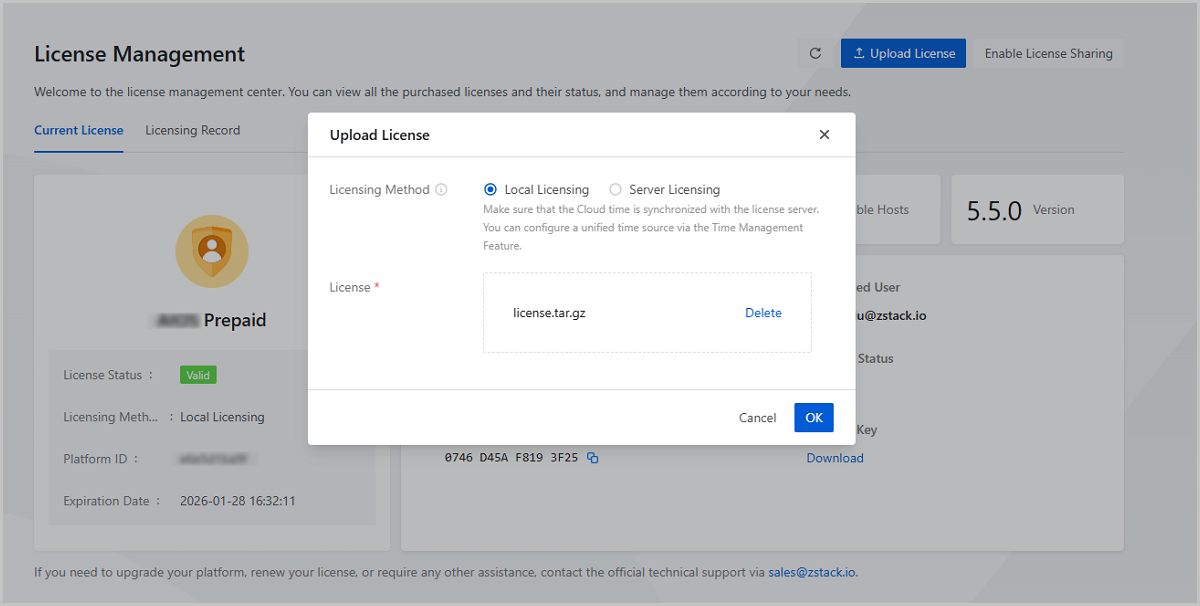
- On the License Management page, click Upload
License in the upper right corner. On the displayed
Upload License window, set the following
parameters:
- Licensing Method: Select Local Licensing.
- License: Upload the license file.
 Note:
Note:
- You can upload both the Base license and Plus license at the same time by using a tar.gz package or a .txt file.
- If you are using a dual-MN environment, we recommend that you download the request key and upload the license file on the management node where the virtual IP address is located. Then, the licensing information on both nodes can be updated.
- Only the admin has the permission to load or delete licenses. Note that the Base license cannot be deleted.
Install License | Command Line
- Import the license by using a command line tool after getting the new
license.
[root@localhost ~]# zstack-ctl install_license -f zstack-license.tar.gz - Refresh the license.Reload the license by using the following commands:
[root@localhost ~]# zstack-cli

  ZStack command line tool
  Type "help" for more information
  Type Tab key for auto-completion
  Type "quit" or "exit" or Ctrl-d to exit

>>>LogInByAccount accountName=admin password=password
{
    "inventory": {
        "accountUuid": "36c27e8ff05c4780bf6d2fa65700f22e",
        "createDate": "May 25, 2016 8:12:54 PM",
        "expiredDate": "May 25, 2016 10:12:54 PM",
        "userUuid": "36c27e8ff05c4780bf6d2fa65700f22e",
        "uuid": "d505bde1bcce46cb9c79774440654f42"
    },
    "success": true
}

>>>ReloadLicense
Renew License
- On the main menu of ZStack Cloud, choose . Then, the License Management page is displayed.
- On the License Management page, click the
Download button next to Request
Key.
图 2. Download Request Key 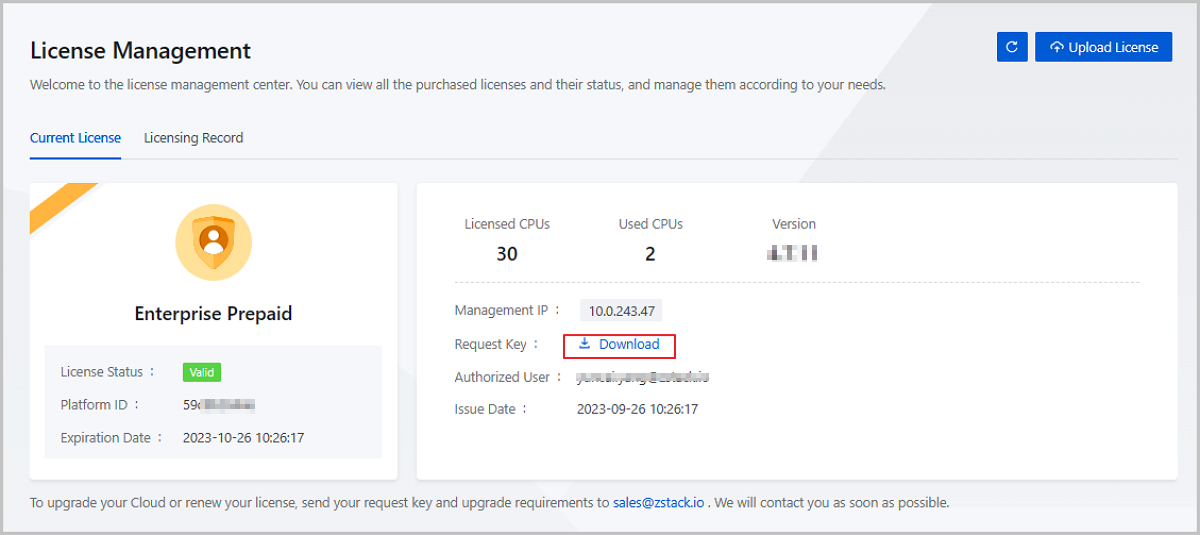
- Apply for a license by using a request key to get the licensing file.
- Go back to the License Management page, upload the licensing file.
- Check whether the licensing information is correct.
Server Licensing
About this task
This topic describes how to use server licensing. The main process includes the following steps:- Prepare a license server.
- Connect to the license server.
Procedure
-
Prepare a license server.
Prepare the license server, and obtain the license server address and port.
-
Connect to the license server.
-
On the License Management page, click Upload License in the upper right corner. The Upload License page is displayed.
Configure the following parameters as needed:
- Licensing Method: Select Server Licensing.
- License Server Address: Enter the license server address.
Note: After server licensing is used, the current environment consumes the license quota on the license server and cannot switch back to local licensing.
-
On the License Management page, click Upload License in the upper right corner. The Upload License page is displayed.
Manage a License
On the main menu of ZStack Cloud, choose . Then, the License Management page is displayed.
| Action | Description |
|---|---|
| Upload License | Upload a license. |
| Copy Key ID | Copy the key ID required to generate a license. You can update the license by using a key ID. |
| Download Request Key | Download the request key required to generate a license. You can update the license by using a request key. |
| Delete Plus License | Delete a Plus license you added to the
Cloud.Note: The Plus licenses obtained by using a USB key cannot
be deleted. |
License Status
| Status | Description |
|---|---|
| Valid | The Base license is in the valid status. |
| Expired | The Base license or a Plus license expired. If a Plus license expires, the corresponding features are unavailable. |
License Exception Reminder
| Exception | Details |
|---|---|
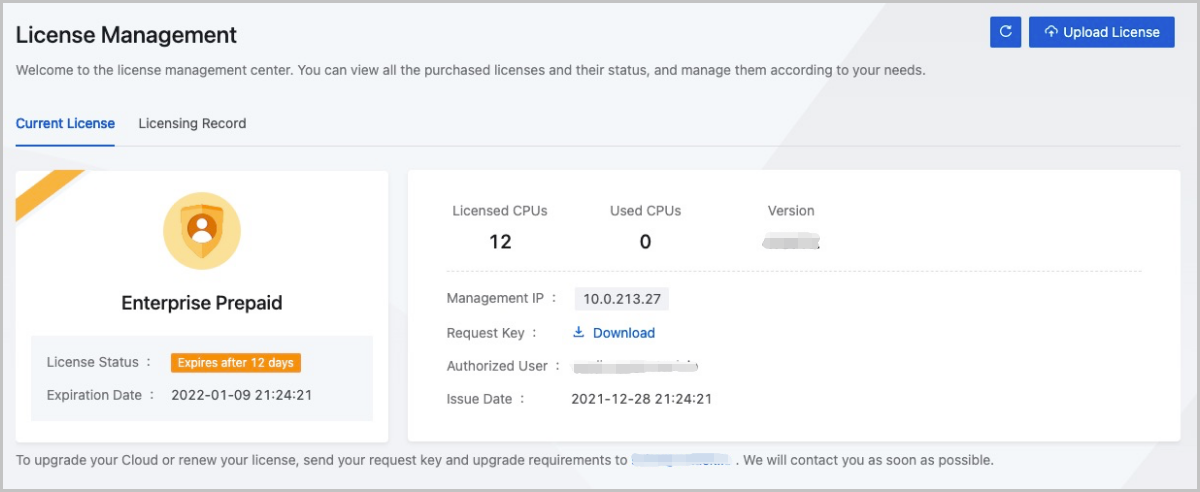
| License to Expire | When the remaining license period is less
than 15 days, a banner prompt will appear after you log in to
the Cloud.Note:
|
| License Expired | When the Base license expired, you will be
redirected to the License Management page
after login. In order not to affect your use of the Cloud, we
recommend that you contact us as soon as possible for
authorization update.Note:
|
| Licensed Quota Exceeds | When you update your license, you may find
that the used resources exceed the authorized quota. In this
case, most features of the Cloud become unavailable. To ensure
your business continuity, we recommend that you update your
license to expand the capacity. The limitations and operations
that you can perform are as follows:
Note:
|
| License Server Disconnected | The Cloud uses server licensing but the
license server is disconnected.Note:
|
Licensing Record
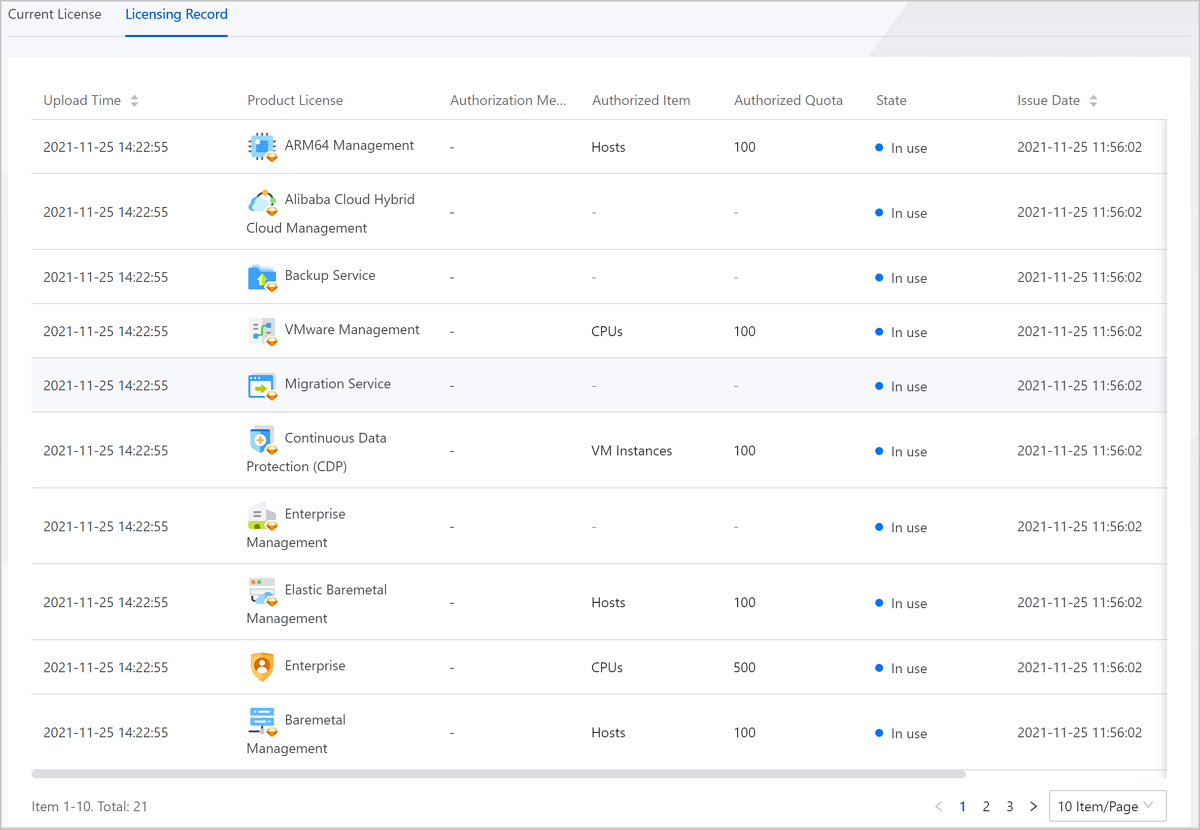
On the main menu of ZStack Cloud, choose . Then, the Licensing Record page is displayed.
The admin can view the licensing records of the Cloud on the UI, including the upload time, license type, authorized items, authorization method, authorized quota, state, time when the license was issued, and time when the license expires.