
Image
What is Image?
An image is a template file used to create a VM instance
or volume. Images are categorized into system images and volume
images.
- A system image contains an OS for running services. You can use a system image to create VM instances. A system image can be of the ISO or Image type.
- A volume image contains only service data. You can use a volume image to create volumes. A volume image can only be of the Image type.
- Image-type images can be in the raw, qcow2, or vmdk format.
- Images are stored on image storage. When an image is used to create a VM instance or volume, the image is downloaded to a primary storage and cached there.
Add an Image
On the main menu of ZStack Cube Ultimate, choose . On the Image page, click Add Image. The Add Image page appears.
The following lists the two image addition scenarios:
- Add a system image.
- Add a volume image.
Add System Image
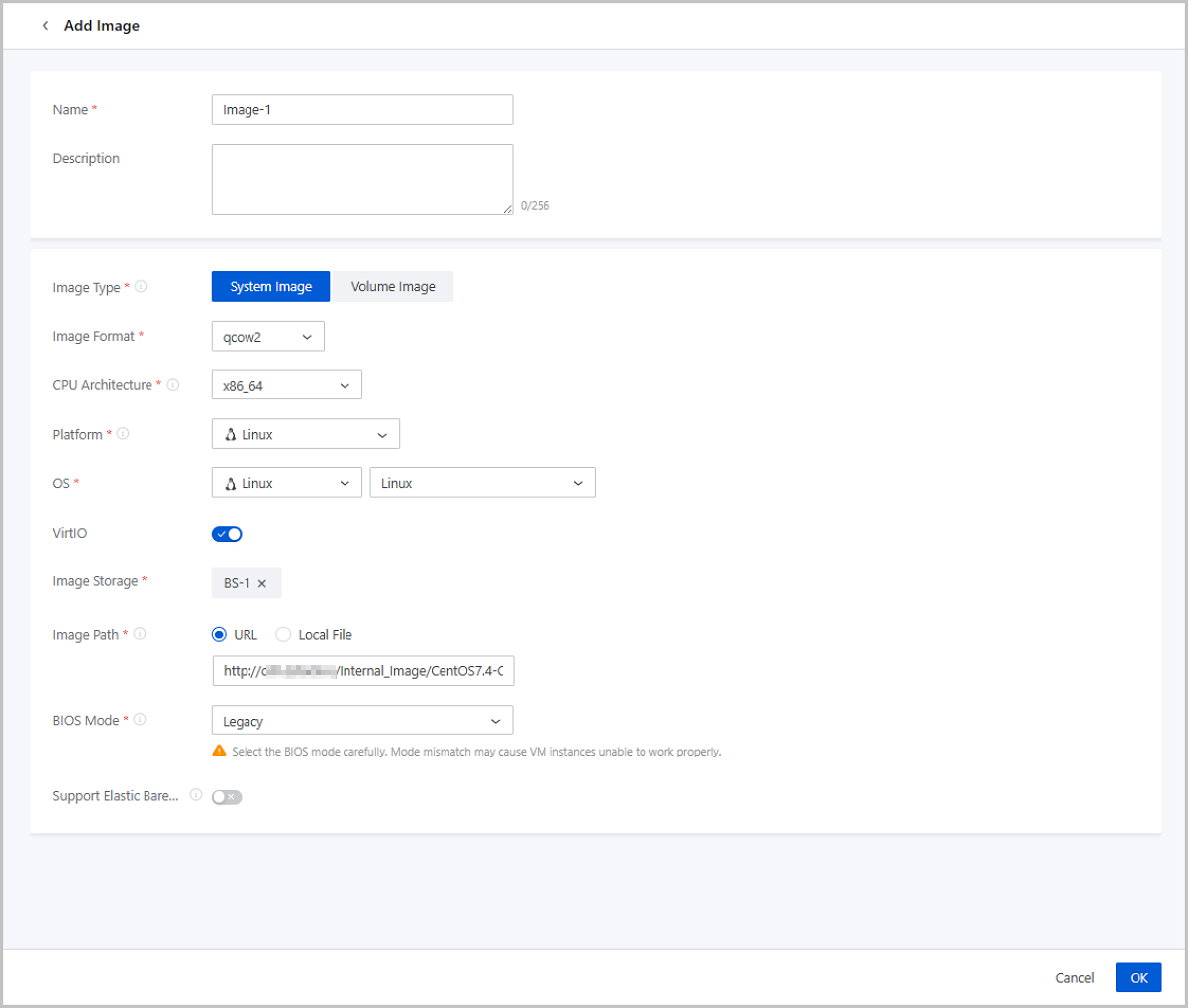
On the displayed page, set the following parameters:
- Name: Enter a name for the image.
The name must be 1 to 128 characters in length and can contain Chinese characters, letters, digits, spaces, hyphens (-), underscores (_), periods (.), parenthesis (), colons (:), and plus signs (+) and cannot begin or end with spaces.
- Description: Optional. Enter a description for the image.
- Image Type: System Image.
- Image Format: Select an image format. You can select
qcow2, iso, raw, or vmdk.
 Note: vmdk-formatted image files will be
auto-converted to qcow2-formatted files if uploaded to an ImageStore
image storage, and to raw-formatted files if uploaded to a Ceph image
storage.
Note: vmdk-formatted image files will be
auto-converted to qcow2-formatted files if uploaded to an ImageStore
image storage, and to raw-formatted files if uploaded to a Ceph image
storage. - CPU Architecture: Select a CPU architecture for the
image. VM instances created from the image use this CPU
architecture.Note: If you select aarch64 or mips64, set the BIOS mode to
UEFI.
- Platform: Select an image platform type.The platform type of an image decides whether the VM instances created based on the image use KVM VirtIO drivers, including VirtIO disk drivers and VirtIO NIC drivers. The following lists the available platform types of an image:
- Linux: If VirtIO is enabled, the image operating system will attach VirtIO drivers, including a VirtIO disk driver and VirtIO NIC driver. If it is disabled, the image operating system will not attach VirtIO drivers, such as RHEL 5.8, and will use a QEMU device instead.
- Windows: If VirtIO is enabled, the image operating system will attach VirtIO drivers, including a VirtIO disk driver and VirtIO NIC driver. If it is disabled, the image operating system will not attach VirtIO drivers and use a QEMU device instaed.
- Other: If VirtIO us enabled, the image operating system will attach VirtIO drivers, including a VirtIO disk driver and VirtIO NIC driver. If it is disabled, the image operating system will use a QWMU device. Platforms of this type allows compatibility with earlier-version operationg systems that do not support VirtIO drivers.
- OS: Select an operating system that is consistent with the image.
- VirtIO: Choose whether to enable VirtIO according to your operating system and platform.
- Image Storage: Select an image storage.
- Image Path: Specify an image URL or upload a local
file:
- URL: Enter a specified URL to add an image.
You can enter a URL by using either of the following syntax:
- A URL that starts with http or https:
- Syntax: http://host[:port]/path/file or https://host[:port]/path/file.
- A URL that starts with ftp:
- Syntax that does not specifies the user: ftp://hostname[:port]/path/file.
- Syntax that specifies the user: ftp://user:password@hostname[:port]/path/file.
- A URL that starts with sftp:
- Syntax that specifies the user identity: sftp://user:password@hostname[:port]/path/file
- User-identity-free syntax: sftp://user@hostname[:port]/path/file.
- The absolute path of an image file that is stored on an
image storage. The image storage that stores the image file
can be an ImageStore image storage.
Syntax: file:///path/file
Note:
- The image file to be added to the destination image storage must exist and the image storage needs to have access to the URL of the image file.
- If you enter a URL that starts with sftp and does not specify user identity, make sure that you enable password-free SSH login to the server that stores the image file.
- For the progress bar and resumption from breakpoint
features:
- If you use an ImageStore image storage, a progress bar will appear to display the upload progress. In addition, upload resumption from breakpoints is also supported.
- If you use a Ceph image storage, a progress bar will appear to display the upload progress. However, upload resumption from breakpoints is not supported.
- If you specify a URL with the
file:/// syntax to add an
image:
- Ceph image storage does not support the file:/// syntax.
- The three forward slashes (/) in file:/// represents the absolute path of a file on an image storage. For example, if you specify the URL file:///opt/dvd/image-1.4.qcow2, you add the image file named image-1.4.qcow2 in the /opt/dvd path of an image storage to the Cloud.
- A URL that starts with http or https:
- Local File: Select a local image file that
the current browser can access and upload the image file to the
specified image storage. The image storage that stores the image
file can be an ImageStore or Ceph image storage.Note: If you upload a local image file, the
local browser serves as a transfer station. Do not refresh or
close the browser or stop management node services. Otherwise,
the image addition may fail.
- URL: Enter a specified URL to add an image.
You can enter a URL by using either of the following syntax:
- BIOS Mode: Select a BIOS mode.
You can select the Legacy or UEFI mode.
- Legacy: This mode supports all operating systems (OSs) and ensures stable operation. We recommend you select this mode.
- UEFI: If the CPU architecture is AArch64 or MIPS64EL, you must select UEFI. This mode supports Windows and CentOS. Note if you use Windows 7 or Windows Server 2008, make sure that the operating system uses CSM.
Note: Mode mismatch may make VM instances unable
to work as expected. Select a mode according to your business needs:- If you add an image in the qcow2 or raw format, select the mode used when the image was created.
- If you add an image in the iso format, you can select either of the two modes. OS will be boot based on the selected mode.
- If you want to boot the OS of a VM instance in UEFI mode, we
recommend that you select a VM image that is created from one of
the OS listed in the following table.
OS BIOS Mode Supported Versions Windows UEFI - Windows 8 or later
UEFI - Windows 7
- Windows Server 2008 R2
Linux UEFI - CentOS 7.2
- CentOS 7.3
- CentOS 7.4 or later
- If you use a Window-based VM instance such
as Windows Server 2012 R2, Windows Server 2016, or Windows 10
that has its OS boot in UEFI mode, the following figure will be
displayed after you start the VM instance. In this case, press
any key to continue the installation of the OS. Otherwise, the
system will enter the UEFI Shell.If you have entered the UEFI Shell, run the following commands to exit the UEFI Shell:
Figure 1. Press Any Key to Continue 
Then press any key in a timely manner. Otherwise, the system will reenter the UEFI Shell.Shell> fs0: FS0:\> dir FS0:\> cd EFI FS0:\EFI\> cd BOOT FS0:\EFI\BOOT\> BOOTX64.EFI
- Enable CSM: Optional. Choose whether to use the
CSM.
The CSM can only be used for OSs that do not support or partially support the UEFI mode.
Note: For Windows 7 and Windows Server 2008
R2, CSM must be enabled. - Support Elastic Baremetal Instance:
Optional. Choose whether the image can be used to create an elastic
baremetal instance. If enabled, the image can be used to create an elastic
baremetal instance. Note: When you add an image of an elastic baremetal
instance, make sure:
- The image has installed the agent. Otherwise, after you use the image to create an elastic baremetal instance, you cannot open the console or modify the password of the elastic baremetal instance. In addition, you cannot attach a volume or network to the instance or detach a volume or network from it.
- The BIOS mode of the image is the same the system configuration. Default: UEFI. If you want to use Legacy, contact the technical support.
Add Volume Image
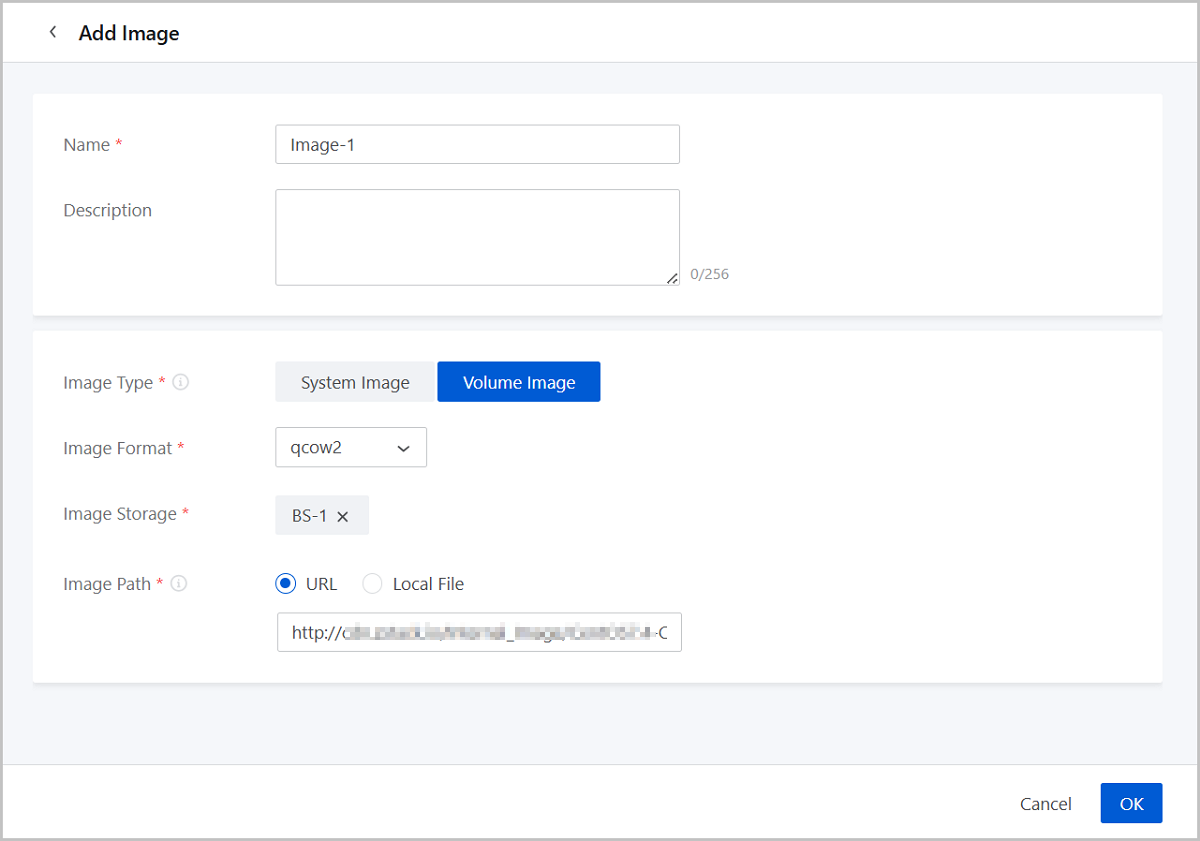
On the displayed page, set the following parameters:
- Name: Enter a name for the image.
- Description: Optional. Enter a description for the image.
- Image Type: Select System Image.
- Image Format: Select an image format. You can select
qcow2, raw or vmdk.Note: vmdk-formatted image files will be auto-converted
to qcow2-formatted files if uploaded to an ImageStore image storage, and
to raw-formatted files if uploaded to a Ceph image storage.
- Image Storage: Select an image storage.
- Image Path: Specify an image URL or upload a local file.
 Note: After an image is uploaded, we recommend that check the image integrity
according to the MD5 displayed on the image detail page.
Note: After an image is uploaded, we recommend that check the image integrity
according to the MD5 displayed on the image detail page.- ZStack Cube Ultimate calculates MD5 of each image uploaded through a URL or a local file, except for images on Ceph image storage.
- If you upload an image of the VMDK format, do not use this MD5 for the integrity verification because a VMDK-formatted image file will be auto-converted to a QCOW2-formatted or ROW-formatted file after the upload, which causes an inevitable MD5 change.
Manage an Image
On the main menu of ZStack Cube Ultimate, choose . Then, the Image page appears.
The following table lists the actions that you can perform on an image.
| Action | Description |
|---|---|
| Add Image | Add an image to an image storage. |
| Edit Image | Edit the name and description of an image. |
| Enable Image | Enable a disabled image. |
| Disable Image | Disable an enabled image. If you disable an image, you cannot use the image to create a VM instance. VM instances created by using the image before the disablement are not affected. |
| Export Image | Export one or more images. ImageStore and Ceph image storage
support image export. Exported images are displayed on the
Exported tab.Note:
|
| Change Image Storage | Migrate data between shared storage across networks. Currently,
this action is supported across Ceph image storage.Note:
|
| Sync Image | Synchronize images that are stored in one or more image storage
to a specified image storage that shares the same monitoring node
with the source image storage. Image synchronization is supported
only by ImageStore image storage.Note: To ease the pressure on the
management network, you can set a network dedicated to image
synchronizations by using either of the two methods:
|
| Set Sharing Mode |
Set the sharing mode of a resource. The
platform provides the following sharing modes:
Note:
|
| Delete Image | Delete an image. A deleted image is displayed on the Recycle Bin tab. |
| Recover Image | Recover a deleted image. If you recover a deleted image, the image is displayed on the Available tab. |
| Expunge Image | Expunge a deleted image.
|
| Download Exported Image | Download an exported image. ImageStore and Ceph image storages
support this action. The download is implemented by the
browser.Note: ImageStore image storage allow you to view the MD5
value of the downloaded image to check whether the downloaded
image is the same as the exported image. |
| Delete Exported Image | Delete an exported image.Note:
|