
Storage Resource
Overview
Storage Resource: A logical unit that provides storage services externally, consisting of a storage cluster.
Related Definitions
- Storage Pool: A storage pool is a logical partition in a storage cluster, which consists of storage severs and data disks to store objects.
- Data Disk: A data disk is a logical storage unit, with each data disk corresponding to one data process. Multiple data disks can form a storage pool based on replication or Erasure Coding (EC) mechanisms.
Storage Pool
Create a General Purpose Pool
On the main menu of ZStack ZStone, choose . On the Storage Pool page, click Create Storage Pool.
- Block Storage Pool
- Object Storage Pool
- File Storage Pool
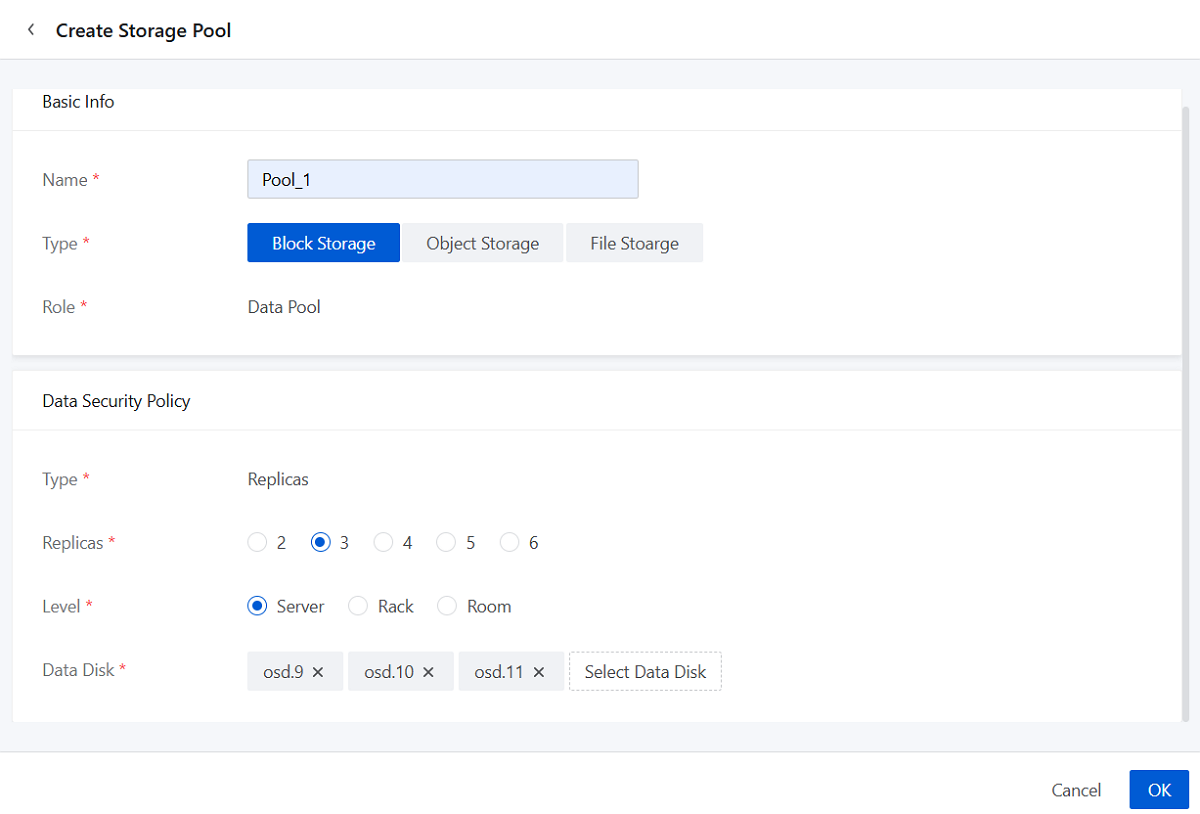
Create a Block Storage Pool
- Name: Set the name for the storage pool.
Naming rules: 1-1288 characters long. A name can contain Chinese characters, letters, digits, spaces, hyphens (-), underscores (_), periods (.), parenthesis (), colons (:), and plus signs (+).
- Type: Select Block Storage.
- Role: The default role is Data Pool and does not support modification.
- Data Security Policy:
- Type: The default type is Replicas and does not support modification.
- Replicas: Set the number of replicas for the
storage pool in the 2-6 value range.
 Note: In production
environments, we recommend setting at least 3 replicas to ensure
data security.
Note: In production
environments, we recommend setting at least 3 replicas to ensure
data security. - Level: Select the level of the failure domain (Server/Rack/Room) according to your topology plan.
- Data Disk: Select data disks based on the topology canvas.Note:
- Selected data disks must meet the redundancy level requirements.
- Select data disks of similar sizes if possible.
Create an Object Storage Pool
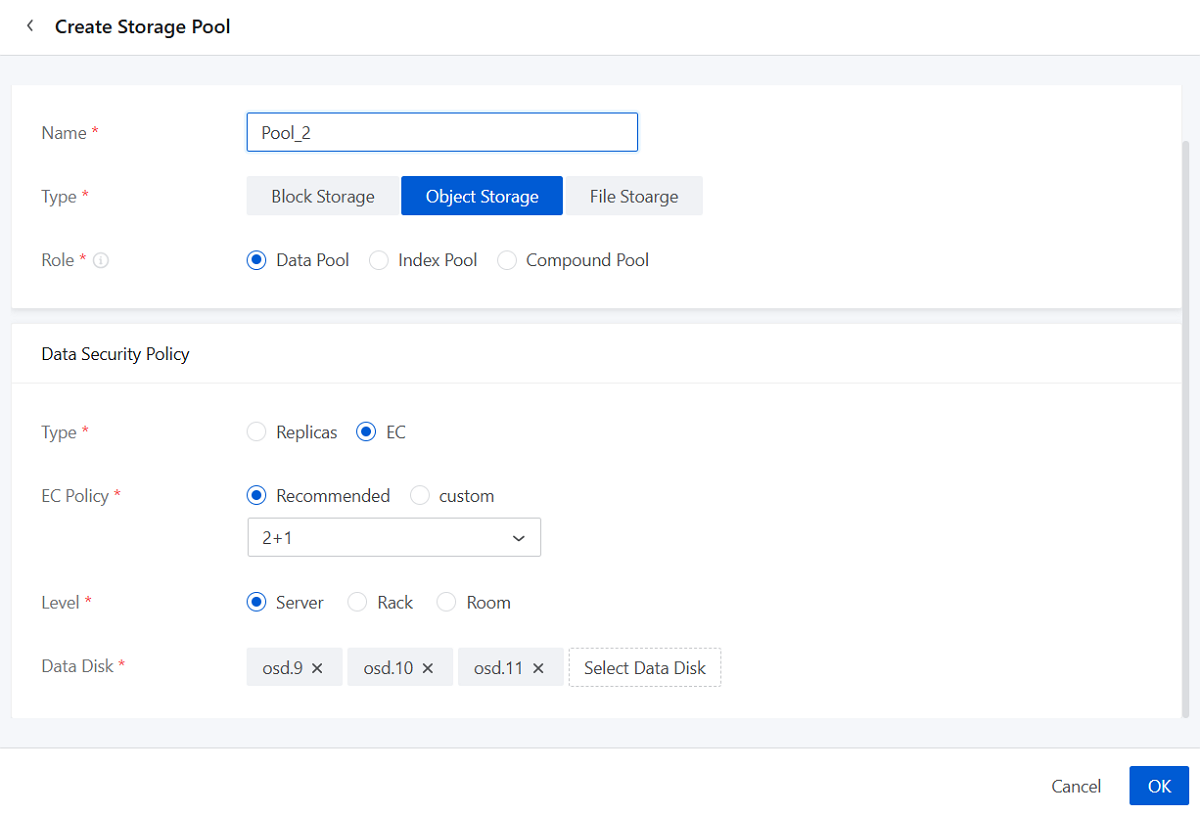
- Name: Set the name for the storage pool.
Naming rules: 1-128 characters long. A name can contain Chinese characters, letters, digits, spaces, hyphens (-), underscores (_), periods (.), parenthesis (), colons (:), and plus signs (+).
- Type: Select Object Storage.
- Role: Select the role of the storage pool (Data Pool,
Index Pool, and Compound Pool).Note:
- Data Pool: Stores data.
- Index Pool: Stores the index information of stored objects.
- Compound Pool: Supports multi-purpose resuse and can be selected as an Index Pool or a Data Extra Pool in Storage Policy.
- Data Security Policy:
- Type: Select data redundancy type
(Replicas/EC).
- If you select Replicas, set the following parameters:
- Replicas: Set the number of replicas for the storage pool in the 2-6 value range.
Note:
- Storage pools with Index Pool or Compound Pool role only support one redundancy policy, that is, Replicas.
- In production environments, we recommend setting at least 3 replicas to ensure data security.
- If you select EC, set the following parameters:
- EC Policy: Set the EC policy
for storage (Recommended/Custom).
- Recommended: Select from six recommended values: 2+1, 4+2, 8+3, 4+2:1, 8+2:1, 16+2:1.
- Custom: Customize the
EC policy. Enter the number of data and parity
blocks.Note: Positive integers only. Make sure
that the number of data blocks is greater than the
number of parity blocks, and parity blocks do not
exceed 4.
Note:
- An EC policy consists of data blocks and parity blocks. Data blocks indicate the number of data shards, while parity blocks indicate the number of parity shards generated through the algorithm. Taking the 4+2 EC policy on the server level as an example. This policy ensures data availability even when 2 servers fail.
- Disk Utilization is displayed in real time. The formula for calculating disk utilization: data blocks/(data blocks + parity blocks).
- EC Policy: Set the EC policy
for storage (Recommended/Custom).
- If you select Replicas, set the following parameters:
- Level: Select the level of the failure domain (Server/Rack/Room) according to your topology plan.
- Data Disk: Select data disks to add based on the
topology canvas.Note:
- Selected data disks must meet the failure domain requirements of the data security policy.
- Select data disks of similar sizes if possible.
- Type: Select data redundancy type
(Replicas/EC).
Create a File Storage Pool
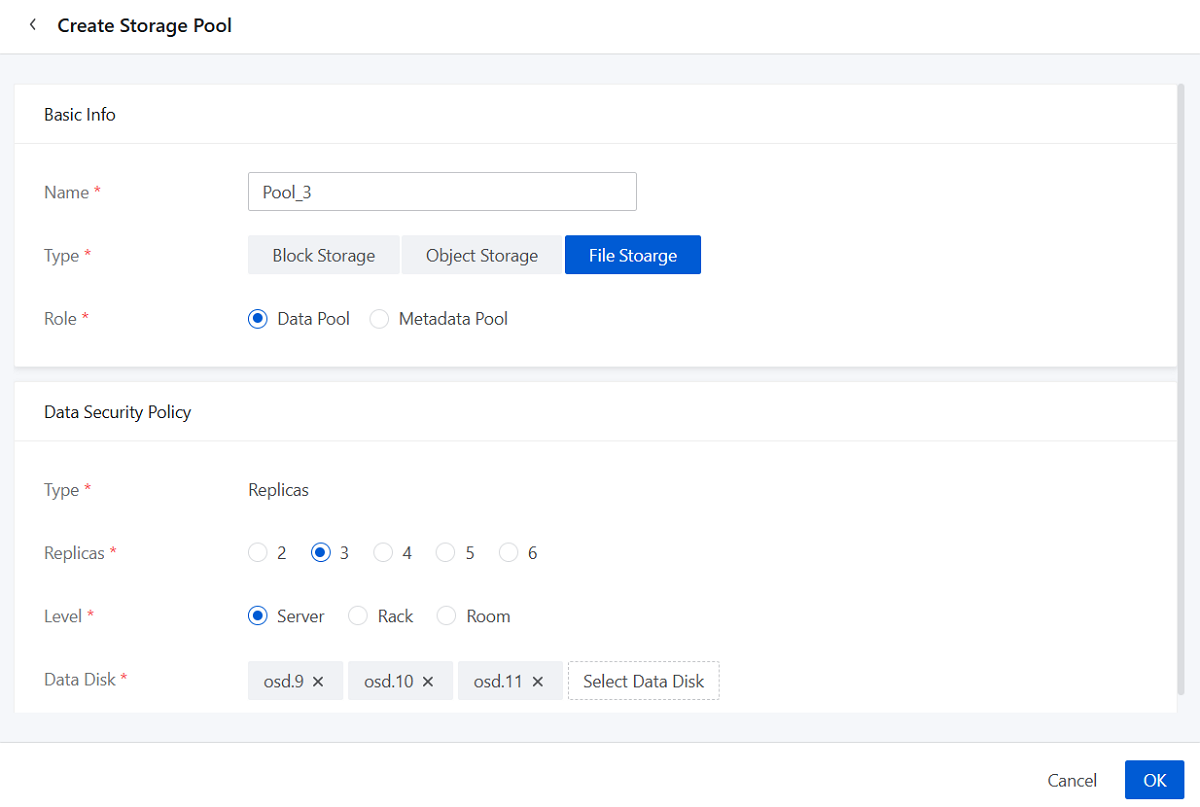
- Name: Set the name for the storage pool.
Naming rules: 1-1288 characters long. A name can contain Chinese characters, letters, digits, spaces, hyphens (-), underscores (_), periods (.), parenthesis (), colons (:), and plus signs (+).
- Type: Select File Storage.
- Role: Select the role of the storage pool (Data Pool/Metadata Pool).
- Data Security Policy:
- Type: The Replicas type has been selected by default and you cannot modify it.
- Replicas: Set the number of replicas for the
storage pool in the 2-6 value range.Note: In production
environments, we recommend setting at least 3 replicas to ensure
data security.
- Level: Select the level of the failure domain (Server/Rack/Room) according to your topology plan.
- Data Disk: Select data disks to add based on
the topology canvas.Note:
- Selected data disks must meet the data redundancy level requirements.
- Select data disks of similar sizes if possible.
- To create a Metadata Pool, you need to use a raw SSD data disk.
Manage a General Purpose Pool
On the main menu of ZStack ZStone, choose . Then, the Storage Pool page is displayed.
| Action | Description |
|---|---|
| Create Storage Pool | Create storage pools. |
| Add Data Disk | Add one or more data disks to the storage pool. |
| Remove Data Disk | Remove a data disk to break the association with
the storage pool. Hence a reduced storage pool capacity. Removing
data disks may cause data losses. Proceed with caution. Note
that you cannot remove data disks if:
|
| Set Recovery QoS | Choose the type of Recovery QoS for storage
pools: Static QoS (Low Speed), Static QoS (Mid Speed), Static QoS
(High Speed). When recovering the pool data, you can check data to
recover, recovery rate, and remaining time on the General
Purpose Pool page.
|
| Check Data Consistency | Set check policy to execute data consistency
checks in the storage pool. We support two check policies:
Note:
|
| Rebalance Data Blocks | Manually rebalance the data blocks in the storage pool.Note:
|
| Modify Data Security Policy | Modify the data security policy for storage
pools. You are not provided with an option that does not meet the
data security requirements.
Note:
|
| Force Flush |
On the details page of a storage pool, click to enter the Data Disk list. You can force flush to rapidly write dirty cache data to backend storage.
Note:
|
| Delete | Delete the existing storage pools. Deleting a
storage pool detaches all data disks from the pool. After deletion,
the storage pool data cannot be recovered. Proceed with caution.Note:
Delete the storage pools of Block Storage type:
Delete the storage pool of Object Storage type:
Delete the storage pool of File Storage type:
|
Create a High-Performance Pool
On the main menu of ZStack ZStone, choose . On the High-Performance Poolpage, click Create Storage Pool.
- Name: Set the name for the storage
pool.
Naming rules: 1-1288 characters long. A name can contain Chinese characters, letters, digits, hyphens (-), underscores (_), periods (.), parentheses (), colons (:), and plus signs (+).
- Type: The default pool type is Block Storage.
- Role: The default role is Data Pool.
- Data Redundancy Type:
- Type: The default redundancy type is Replicas.
- Replicas: 3 replicas are supported.
- Data Disk: Select the
data disk to add.Note: Ensure the selected data
disks use the same interface protocol.
Manage a High-Performance Pool
On the main menu of ZStack ZStone, choose . Then, the High-Performance Pool page is displayed.
| Action | Description |
|---|---|
| Create Storage Pool | Create high-performance storage pools. |
| Add Data Disk | Add one or more data disks to the storage pool.
Note: Ensure that the added data disk share the same interface
protocol with other data disks within the pool. |
| Remove Data Disk | Remove a data disk to break the association with
the storage pool. Hence a reduced storage pool capacity.Note:
|
| Set Recovery QoS | Choose the type of Recovery QoS for storage
pools: Static QoS (Low Speed), Static QoS (Mid Speed), Static QoS
(High Speed). When recovering the pool data, you can check data to
recover, recovery rate, and remaining time on the
High-Performance Purpose Pool page.
|
| Delete | Delete the existing storage pools. Deleting a
storage pool detaches all data disks from the pool.Note: To delete a
high-performance pool requires meeting the following
requirements:
|
Object Storage System Resources Pool
On the main menu of ZStack ZStone, choose . Then, the Object Storage System Resources Pool page is displayed.
The object storage system resources pool is created to store metadata when initializing object storage and shares the same data disks and data security policy with the storage pool selected for initializing object storage.
Check Object Storage System Resources Pools
- .rgw.root: Stores gateway configuration information, such as realm, zonegroup, and zone.
- .rgw.control: Stores objects that are needed for internal notification mechanism, including notify.0-notify.7.
- .rgw.log: Stores log information, such as gc, intent, usage, and reshard.
- .rgw.meta: Stores metadata of the user, such as user.uid and user.keys.
- .rgw.otp: Stores one-time password in multi-factor authentication.
Further Details About Storage Pool
On the main menu of ZStack ZStone, choose . On the Storage Pool page, click one pool's name and enter its details page.
On the details page, four aspects of the storage pool are shown in card form: Basic Info, Capacity Statistics, Monitoring Data, and Capacity Monitoring.
Basic Info
You can check the basic information including state, type, role, pool UUID, the number of data disks, data redundancy type, and QoS type of the current storage pool.
Capacity Statistics
- Capacity Allocation: Contains three parameters, namely, Raw Capacity, Data
Redundancy Type, and Total Capacity.Note:
- For pools of the Replicas policy type: Total Capacity = Raw Capacity ÷ Replica Number.
- For pools of the EC policy type: Total Capacity = Raw Capacity × Data Blocks ÷ (Data Blocks + Parity Blocks).
- Capacity Usage: Contains four parameters, namely, Total Capacity, Capacity Used, Capacity Available, and Capacity Utilization.
Monitoring Data
- You can check IOPS, bandwidth, and latency of the storage pool.
- Time Span: 15 minutes, 1 hour, 6 hours, 1 day, 1 week, 1 year, and custom.
Capacity Monitoring
Note:
- Only when a newly-created storage pool has been used for 12 hours can it be forecast the capacity.
- This card statically displays data. You can obtain the latest data by refreshing the page or re-enter the same details page.
Data Disk
Create a Data Disk on General Purpose Node
On the main menu of ZStack ZStone, choose . On the Data Disk page, click Create Data Disk.
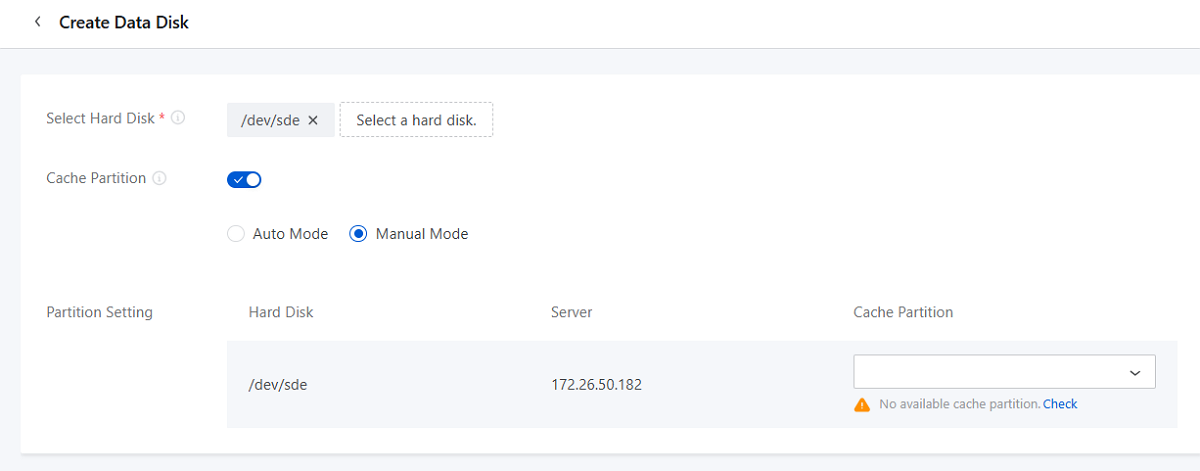
- Select Hard Disk: Select the hard disk to add as a data
disk.Note: You can add hard disks that are healthy, free, and of at least 25
GB size as data disks.
- Cache Partition: Choose whether to set cache partition
for data disks.
- Auto Mode: If you select auto mode, the system automatically attaches cache partitions provided by servers to the selected hard disks.
- Manual Mode: If you select manual mode, you can manually select cache partitions for each hard disk that has been selected.
Note: If available cache partitions are insufficient for the selected hard
disks when you enable this parameter, part of the hard disks fail to be
added as data disks.
Manage a Data Disk on General Purpose Node
On the main menu of ZStack ZStone, choose . Then, the Data Disk page is displayed.
| Action | Description |
|---|---|
| Create Data Disk | Create one or more data disks. |
| Set Maintenance Mode | Enable or disable the maintenance mode for data
disks. A data disk in the maintenance mode is not involved in data
block rebalances.Note:
|
| Delete | Deleting a data disk stops services provided by
the data disks and deletes all relevant data. The deleted data
cannot be recovered. Proceed with caution.Note: To delete a data
disk requires meeting these requirements:
|
Create a Data Disk on High-Performance Node
On the main menu of ZStack ZStone, choose . On the Data Disk page, choose .
Note: To create a data disk on high-performance node, make sure you have planed a topology
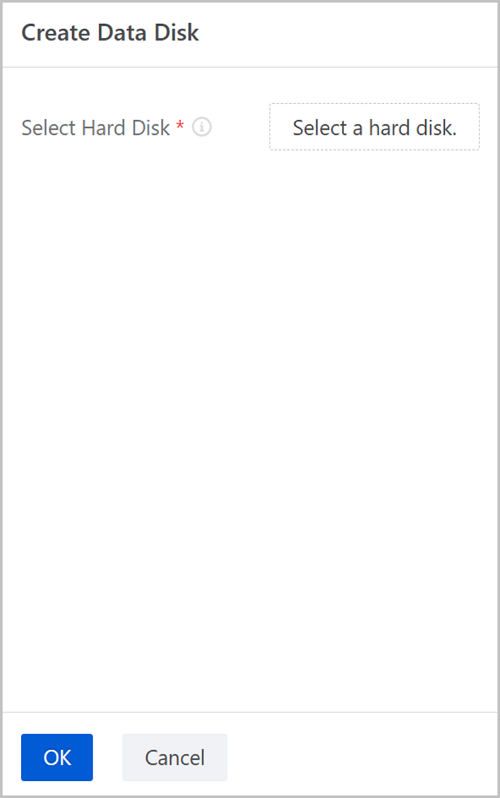
before. Otherwise, the creation will fail.- Select Hard Disk: Select the hard disk to add as a data
disk.Note: Only Solid State Drives (SSDs) can be added as data
disks.
Manage a Data Disk on High-Performance Node
On the main menu of ZStack ZStone, choose . Then, the High-Performance Node page is displayed.
| Action | Description |
|---|---|
| Create Data Disk | Create one or more data disks. |
| Delete | Deleting a data disk stops services provided by
the data disks and deletes all relevant data. The deleted data
cannot be recovered. Proceed with caution.Note: To delete a data
disk requires meeting one requirement:
|