
Instance Offering
What is Instance Offering?
An instance offering defines the number of vCPU cores, memory size, network bandwidth, and other configuration settings of VM instances.
Create an Instance Offering
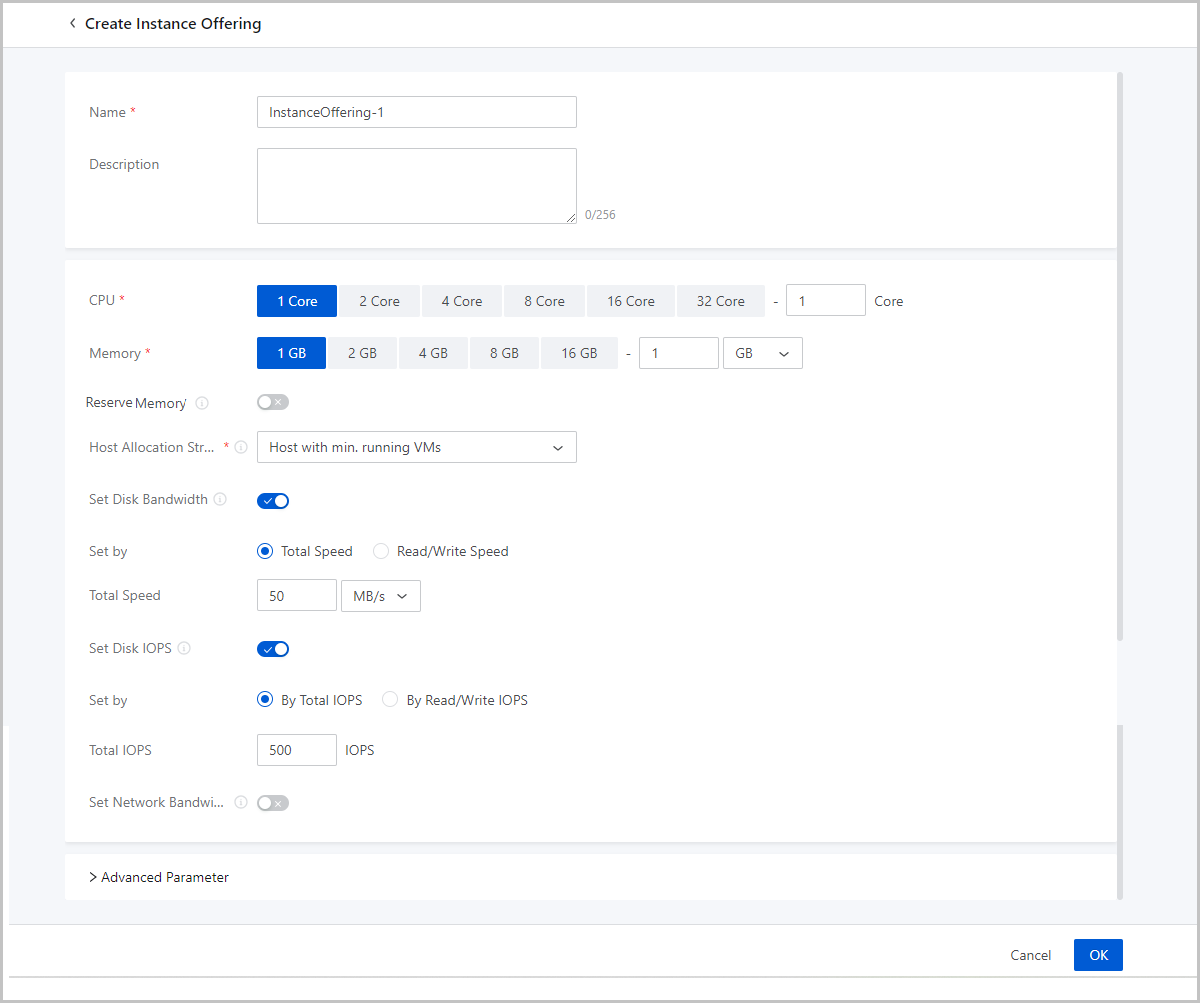
On the main menu of ZStack Cloud, choose . On the Instance Offering page, click Create Instance Offering. Then, the Create Instance Offering page is displayed.
- Name: Enter a name for the instance offering.
The instance offering name must be 1 to 128 characters in length and can contain Chinese characters, letters, digits, hyphens (-), underscores (_), periods (.), parenthesis (), colons (:), and plus signs (+).
- Description: Optional. Enter a description for the instance offering.
- CPU: Set the CPU cores of the VM instances to be created by the instance offering. Note that this value must be an integer. Unit: core. Valid values: 1 to 1024.
- Memory: Set the memory size of the VM instances to be created by the instance offering. Note that this value must be an integer. Unit: MB, GB, and TB. Valid values: 16 MB to 100 TB.
- Reserve Memory: The minimum memory that ensures the normal running of the VM instance. By default, this feature is disabled. If you enable this feature, make sure that the reserved memory is less than the memory defined in the instance offering.
- Host Allocation Strategy: Specify how
the Cloud allocates a host for you to create a new VM instance. Default
strategy: Host with min. running VMs.
- Host with min. running VMs: Allocates the host with the least running VM instances to the new VM instance.
- Host with min. CPU utilization: Allocates the host with the
minimum CPU utilization to the new VM instance.
 Note:
Note:
- The Cloud collects the host CPU loads over a period of time, calculates the average CPU utilization, and selects the host with the lowest CPU utilization to create the new VM instance.
- By default, the Cloud collects data at an interval of 10
minutes. You can change the collection cycle through the
following method:
Choose , and edit Host CPU Utilization Collection Interval.
- Host with min. memory utilization: Allocates the host with the
minimum memory utilization to the new VM instance.Note:
- The Cloud collects the host memory loads over a period of time, calculates the memory average utilization, and selects the host with the lowest memory utilization to create the new VM instance.
- By default, the Cloud collects data at an interval of 10
minutes. You can change the collection cycle by using the
following method:
Choose , and edit Host Memory Utilization Collection Interval.
- Host with max. running VMs: Allocates the host with the most running VM instances to the new VM instance. Before you can use this option, set the maximum number of VM instances that can run on a host. Then, the Cloud selects a host that meets the requirements to create the new VM instance. If no host is available, you will fail to create it.
- Host where the VM located last time: When you restart a stopped
VM instance, the Cloud allocates it with the host where it was running
last time. Note: If you start a VM instance for the first time, the
Cloud allocates a host randomly.
- Random allocation: Randomly allocates a host to create the new VM instance.
- Set Disk Bandwidth: Optional. Set an upper limit for the
I/O bandwidth of a volume.If not set, the I/O bandwidth of the volume is not limited. Unit: MB/s, GB/s, and TB/s. You can set the I/O bandwidth by using either of the following methods:
- Total Speed: Set an upper limit for the total read and write speed of the volume.
- Read/Write Speed: Set an upper limit for the
read or write speed of the volume.
- Read Speed: Optional. Set an upper limit for the read speed of the volume.
- Write Speed: Optional. Set an upper limit for the write speed of the volume.
- Set Disk IOPS: Optional. Set an upper limit for
reads/writes per second (IOPS) of a volume.If not set, the IOPS of the volume is not limited. You can set the IOPS by using either of the following methods:
- Total IOPS: Set an upper limit for the total IOPS of the volume.
- Read/Write IOPS: Set an upper limit for the
read or write IOPS of the volume.
- Read IOPS: Optional. Set an upper limit for the read IOPS of the volume.
- Write IOPS: Optional. Set an upper limit for the write IOPS of the volume.
- Set Network Bandwidth: Optional. Set an upper limit for
the network bandwidth of a VM instance created by the instance offering.If not set, the network bandwidth of the VM instance is not limited. Unit: Kbps, Mbps, and Gbps. You can set the network bandwidth by using either of the following methods:
- Upstream Bandwidth: Optional. Set an upper limit for the network bandwidth used by the VM instance to upload data.
- Downstream Bandwidth: Optional. Set an upper limit for the network bandwidth used to download data from the VM instance.
Note: Before you make any settings, make sure that you fully
understand the configurations of the disk bandwidth and network bandwidth.
Otherwise, you might fail to upload files to or download files from a VM
instance. - Advanced Parameter: Optional.
Configure a JSON file to customize disk performance.Sample:
The preceding configuration settings can be divided into the following three parts:{ "allocate": { "primaryStorage": { "type": "Enter a primary storage type. Valid values: Ceph, LocalStorage, NFS, and SharedBlock.", "uuid": "Enter the UUID of the primary storage.", "poolNames": [ "Enter a name for the Ceph pool. Delete this parameter if you do not specify a Ceph primary storage." ] } "clusterUuid":"Enter the cluster UUID." }, "priceUserConfig": { "rootVolume": { "priceKeyName": "Set the billing name for the root volume. Make sure that the advanced parameter setting in the pricing list is consistent with the setting here. Otherwise, the corresponding billing entries cannot be generated." } }, "displayAttribute": { "rootVolume": { "diskType": "Set the display type of the root volume. You can view this parameter setting on the VM details page." } } }- Set a primary storage and cluster for the root
volume.
"allocate": { "primaryStorage": { "type": "Enter a primary storage type. Valid values: Ceph, LocalStorage, NFS, and SharedBlock.", "uuid": "Enter a primary storage UUID.", "poolNames": [ "Enter the name of a Ceph pool. Delete this parameter if you do not specify a Ceph primary storage." ] } "clusterUuid":"Enter a cluster UUID." }- type: Enter a primary storage type. Valid values: Ceph, LocalStorage, NFS, and SharedBlock. If you specify a Ceph primary storage, you can specify a Ceph pool.
- uuid: Enter a primary storage UUID.
- poolNames: Enter the name of a Ceph pool. Delete this parameter if you do not specify a Ceph primary storage.
Note: If you do not need to specify a primary storage or a
cluster, delete the corresponding codes. - Set a billing type for the root
volume.
"priceUserConfig": { "rootVolume": { "priceKeyName": "Set a billing name for the root volume. Make sure that advanced parameter setting in the pricing list is consistent with this setting. Otherwise, the corresponding billing entries cannot be generated." } }- priceKeyName: Set a billing name for the root volume. Make sure that advanced parameter setting in the pricing list is consistent with this setting. Otherwise, the corresponding billing entries cannot be generated.
Note: If you do not need billing settings, delete the preceding
parameter settings. - Set the display attribute of the root
volume.
"displayAttribute": { "rootVolume": { "diskType": "Set the display type for the root volume. You can view this parameter setting on the VM details page." } }- rootVolume: Set the display type for the root volume. You can view this parameter setting on the VM details page. You can also set multiple attributes in key-value pair format.
Note: If you do not need special display, delete the
corresponding codes.
- Set a primary storage and cluster for the root
volume.
Manage an Instance Offering
On the main menu of ZStack Cloud, choose . Then, the Instance Offering page is displayed.
| Action | Description |
|---|---|
| Create Instance Offering | Create an instance offering. |
| Edit Instance Offering | Edit the name and description of the instance offering. |
| Enable Instance Offering | Enable the instance offering when it is disabled. |
| Disable Instance Offering | Disable an enabled instance offering. |
| Set Sharing Mode |
Set the sharing mode of a resource. The
platform provides the following sharing modes:
Note:
|
| Delete Instance Offering | Delete the instance offering. In this case, a dialog box will be displayed, asking you to confirm the deletion action. |